
Welcome to our training
What a karate session actually is, and who it is for. The answer is shorter than you might expect, and wider.
What a session is really for
A karate session is not a class that leads somewhere else. The class is the place. You come in, you breathe, you bow, you work, and at the end you bow again and go. The work is not a preparation for a fight, a competition, or a show; the work is the work. That is the difference between the do in karate-do and karate as a sport: the path is the destination, and the destination keeps moving.
In practice that means the session is less a test and more a practice. You are not graded on what you did yesterday; you are shaped by what you do today. The only audience is yourself, and the only mark that matters is the one you leave behind on the dojo floor.
Every age, every ability
This is a club that has been training people who were eight years old, who were sixty, and who were anywhere in between, at the same time and in the same dojo. From beginners to seniors with dan grades.
The dojo does not ask your age, your fitness, your previous experience, or your size. It only asks that you arrive with respect and a willingness to try. If that is you, there is a place for you on the floor.
No age too old
People have started karate at sixty, at seventy, and at eighty. The body is slower to learn than it was at twenty, and it is quicker to thank you than it was at twenty. The art keeps pace with you, and so do we.
No ability needed
There is no fitness test at the door, and no previous experience required. Ability is what you do in this hour, not what you could do last year. Every technique can be done in a way that suits the body you bring.
A friendly dojo
There is no elitism, no full-contact fighting, and no ranking table at the back of the room. There is a bow, a session, and the quiet satisfaction of having trained well. That is the whole transaction.
The shape of a session
Every Friday from 6pm to 7pm, the arc is the same, though no two Fridays are quite the same. You can watch it happen from a corner of the room on your first visit, or simply come along and feel it from the inside; that is the better way.
- Opening bow: we settle the mind before the body, and put the week to one side. Two or three minutes, and it is the most important part of the hour.
- Warm-up: joint work, light footwork, and enough movement to wake the muscles without tiring them.
- Kihon and katas: the building blocks and the forms. This is where the art lives: the same movement, done a little better than last week.
- Light partner work: simple controlled exchanges to feel distance, timing, and the space between you and a partner. Nothing to hurt anyone; a great deal to learn about yourself.
- Cool-down, closing bow, and a word: a short debrief, a question or a thank you, and out the door with the week a little quieter than it went in.
Why "traditional" still matters
You will hear the word "traditional" used a lot about us. It is not a badge or a brand; it is a description. We train karate as an art, not a sport. We do not score points, we do not compete for placement, and we do not chase the faster or flashier version of a technique when a slower, more honest one is on the table. The old masters did not train for the podium, and we do not either. We train for the long road that has no podium at all, and we find we like the view from that road.
A little of our history, and a little of our shelf
We are not a big club, and we do not pretend to be. We are a small, friendly, serious little dojo in Oxford, and we are quite proud of the people who have trained here over the years. The poster, the master texts on the shelf, and the dojo floor itself are about the whole of our physical world.
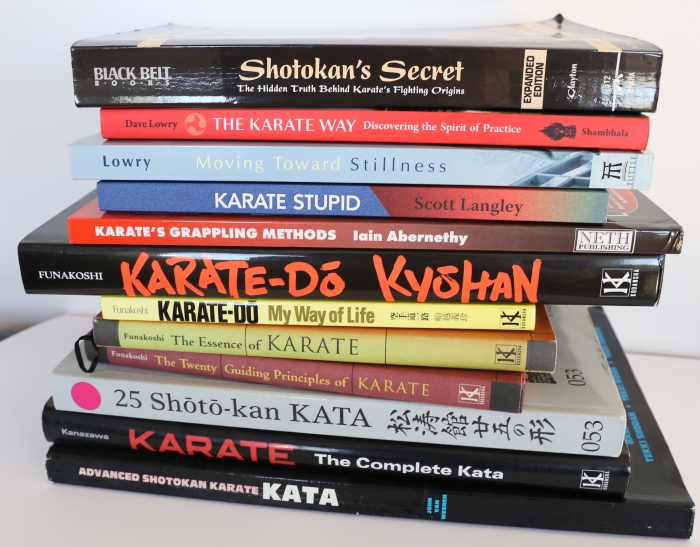
The master texts we turn to when a technique needs a why behind it. The full list, with a few honest recommendations about where to start, lives on the further reading page.
When you are ready
You do not need to sign up to anything to come to a class. Just show up on a Friday with loose clothing and a little curiosity, and stay for the bow. For safety, we do ask you to fill in a short emergency contact and waiver form before your first session. After that, if it feels right, we are happy to talk about membership and the rest. If it does not, that is perfectly all right too.